
Hamilton Resident Lookup Records
A Hamilton resident lookup is a process of matching the record to the question. Hamilton’s Butler County Auditor can identify the tax-listed owner, parcel, situs address, and tax-bill mailing field. The Hamilton Recorder route can confirm that a named party signed or received a recorded instrument. The voter tool used for a Hamilton search confirms an individual registration record, while Hamilton court and probate systems identify parties and case events. No Hamilton source is a complete list of people in a home. For Hamilton family, estate, reconnection, civic, or scam-verification research, keep each source in its proper lane.
| Record | Question it can answer | Hamilton or Ohio route | Important boundary |
|---|---|---|---|
| Hamilton Auditor parcel roll | Tax-listed owner, parcel facts, transfer clues | Butler County Auditor Property Search for Hamilton parcels | Owner and mailing fields do not prove occupancy. |
| Hamilton recorded document | Party to a deed, lien, mortgage, or release | Butler County Recorder Official Record Search for Hamilton land | A recorded party is not necessarily a resident. |
| Hamilton individual voter record | Registration, precinct, and voting-history status | Ohio Voter Lookup and Butler County Board of Elections | Protected records and confidential fields are excluded. |
| Hamilton court or probate file | Party name, case number, event, estate, or filed will | Hamilton, Butler County, or Probate court route | Choose the correct court and verify delayed displays. |
| Hamilton vital certificate or index | An event fact that helps resolve identity or time | Hamilton Vital Statistics, health district, Probate, or archives | It is not a current-address directory. |
Start with the Hamilton fact that has the least room for confusion. A known Hamilton street can lead to a parcel and then a recorded transfer. A known Hamilton case number belongs at the relevant court. A possible Hamilton marriage or estate trail belongs with Probate Court, not the Auditor. If only a full name is known, make a short list of variants before searching. A maiden name, middle initial, suffix, or former county can explain a no-match without proving that the person was never in Hamilton.
Note: A record can confirm one fact about a Hamilton resident without establishing present occupancy, identity, or a relationship to another person.
Confirming a Hamilton Resident Lookup
Before treating two Hamilton results as one person, capture a fixed anchor from the first official source. Hamilton’s Auditor accepts owner searches as LastName FirstName, without a comma, and supports partial names with an asterisk wildcard. A parcel ID, legal description, document number, case number, license number, or precinct is much stronger than a common name paired only with a Hamilton street. Compare Hamilton dates as well. A Recorder date records an instrument, an Auditor transfer date marks a different event, and a directory date is tied to publication.
The Butler County Auditor’s Hamilton parcel card gives useful identity pivots without turning them into conclusions. The public Hamilton result separates the place where the parcel sits from the name and address that receive the tax bill. It also gives the legal-description and transfer information needed to test a Hamilton Recorder result. Those distinctions matter when a Hamilton property belongs to an estate, company, agent, or person who lives elsewhere.
- Parcel ID: a stable identifier for the property record.
- Situs address: the physical parcel location.
- Tax-bill mailing field: a correspondence destination, not occupancy proof.
- Owner lines: the tax-listed ownership display.
- Legal description and transfers: the bridge to recorded documents.
Hamilton Courts in a Resident Lookup
Hamilton court records can test whether a name appeared in a case, but they do not establish a current residence by themselves. Hamilton Municipal Court is its own city-court route. Hamilton’s Butler County Common Pleas and Clerk of Courts handle county-level matters, while the Area Courts and Probate Court have separate systems. The Clerk reports electronic cases from 2000 forward, with older Hamilton files at the Records Center. For a Hamilton record that needs more than the screen can show, preserve the court name, case number, and date before asking the clerk for the specific existing item.
The public view of Butler County Area Courts CaseLook appears in this captured screen.
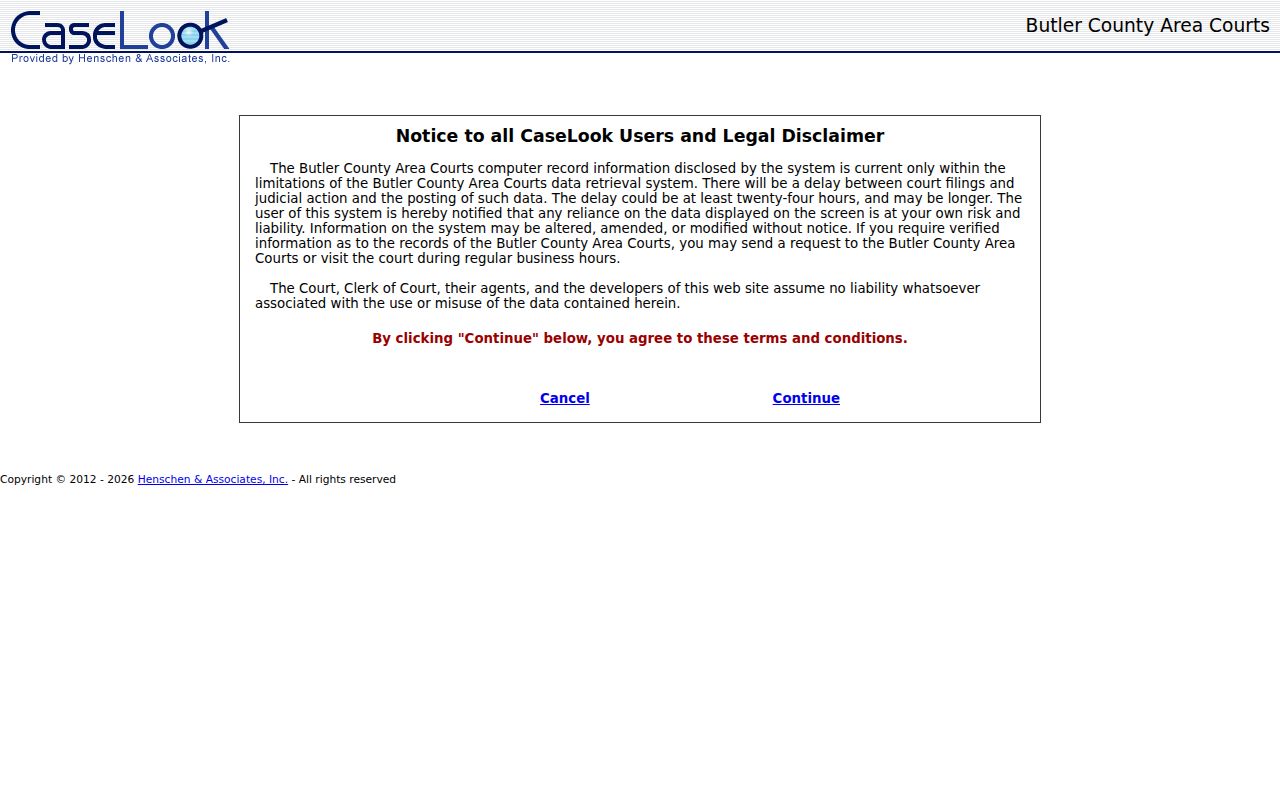
Use the Hamilton result as a pointer to a case and court, then confirm the underlying filing with that court when accuracy matters.
The Butler County Clerk of Courts homepage is also captured below.
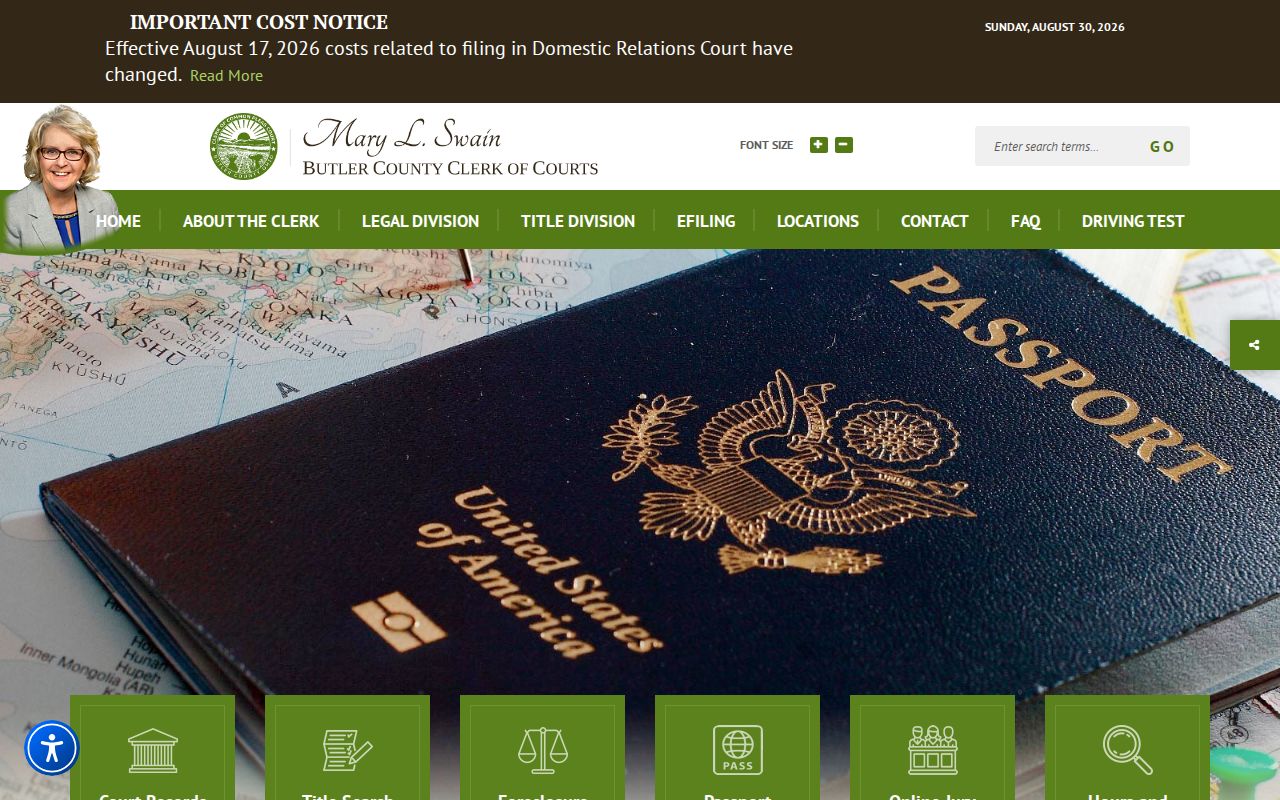
The Hamilton Clerk accepts copy requests by mail, email, fax, or in person, but does not research or create a new report. Public portions are released after sensitive material is redacted.
Note: Preserve the court name, case number, and date before seeking a copy, because Butler County court systems have separate jurisdictions.
Hamilton Resident CaseLook Delay
Myth. A case that is not on a court screen cannot be treated as proof that it does not exist. Hamilton Municipal Court and Butler County Area Courts warn that online entries can lag by at least 24 hours. Hamilton Municipal Court relocated to 700 Hanover Street on January 27, 2025, another reason to verify the current court channel instead of relying on an old contact trail. Calendar information can list a party, case number, time, event type, and judge, but a calendar entry is not a final disposition.
Use Hamilton Municipal Court for the city court, the Hamilton Clerk for Common Pleas matters, Hamilton Probate for estates and related filings, and the Area Courts portal for its own jurisdictions. Juvenile, sealed, expunged, adoption, civil-commitment, and other protected material are not ordinary public lookup paths. A Hamilton court can confirm its own records and access rules; a neighboring court cannot fill the gap.
Verify a Hamilton Resident Lookup
A careful Hamilton resident lookup uses a second custodian to test the first result. For example, match the current Hamilton Auditor owner display to a Recorder grantor or grantee only after the legal description or parcel clues line up. For an old Hamilton household, compare the directory publication year with a map, census period, or deed. When the issue is a Hamilton court record, ask the court to verify the docket rather than treating a web listing as final. Each comparison should add a distinct fact, not repeat the same database in another format.
- Search the Hamilton Auditor by the name format it accepts, then save the parcel ID, situs, legal-description clue, and transfer date that fit the person.
- Use the Hamilton Recorder to compare the buyer, seller, document date, number, book/page, or legal description. Keep the same parcel or subdivision in view.
- For a Hamilton civic or court lead, choose the correct official system and search reasonable name variants. Record the court and case number, not only the name.
- Request a named existing Hamilton record from the custodian when a certified or verified copy is needed. Do not ask an office to build a new list of residents.
- Docket
- The court’s running record of events in one case, such as filings, hearings, and orders.
- Index and image
- An index points to a record. An image is the scanned document itself. Seeing an index result does not mean every document is available.
- Certified copy
- A copy issued and certified by the custodian for situations that require an official record rather than a research copy.
Keep a small Hamilton research log as the records converge. Note the spelling searched, the date of the Hamilton search, the portal or office, and the Hamilton parcel, document, or case number returned. That record of the process makes it easier to spot a same-name error and to ask the custodian for the exact item later.
Hamilton Resident Vital Trails
Hamilton Probate records can be a responsible endpoint for an estate or heir question after the identity and time period are independently anchored. The Butler County Probate record search for Hamilton permits one search piece at a time, offers case-type selection, and includes a matches-per-page control. Once filed, a Hamilton will is public, but Local Rule 55.1 restricts access to adoption, civil-commitment, and other confidential files. Ordinary copies are listed at $0.10 per page and certified copies at $2 per page under ORC 2101.16(A).
The captured Probate search screen shows the separate route used for this part of a Hamilton resident lookup.
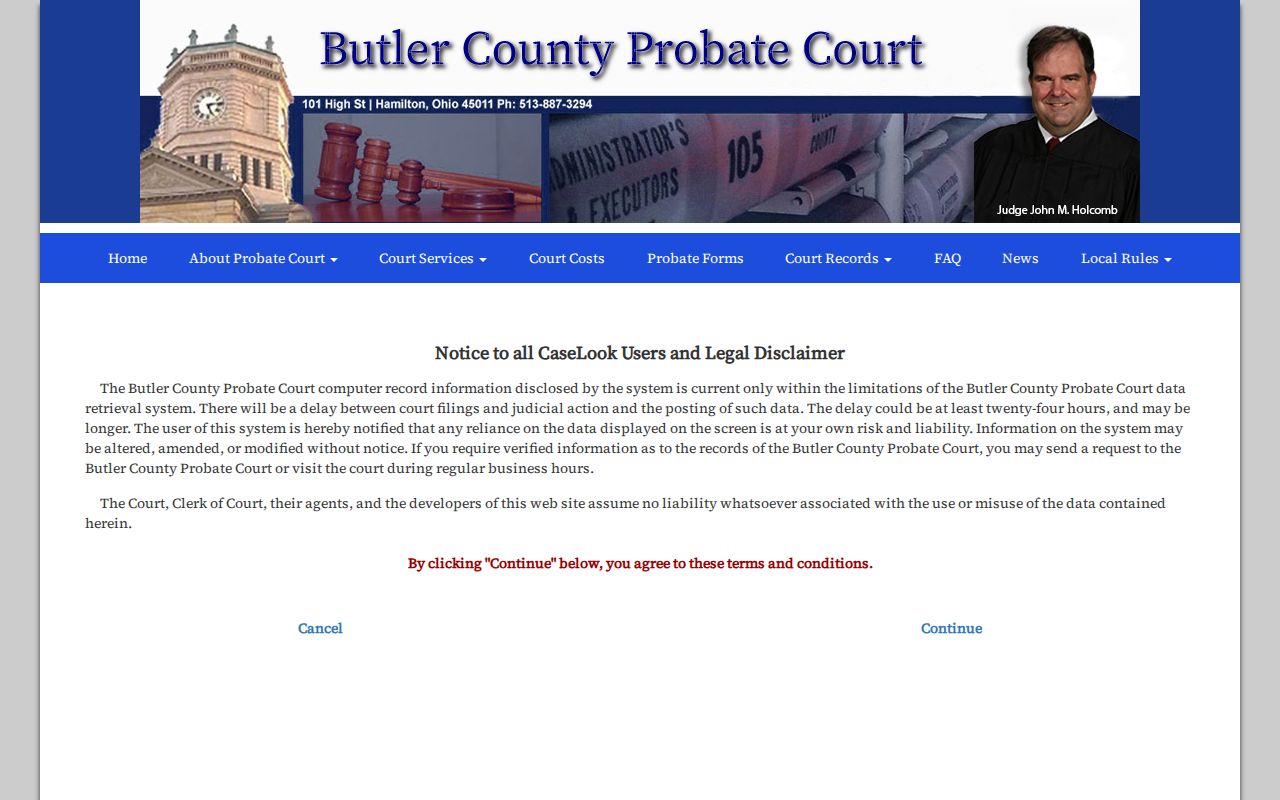
Hamilton Probate evidence may name a fiduciary or heir, but it does not promise a present Hamilton address and must be read with the court’s privacy rules.
Hamilton Resident Vital-Access Myth
Myth. Ohio does not impose a universal 100-year birth or 50-year death closure on Hamilton certificates. ORC 3705.23 directs the state or local registrar, on a signed application and fee, to issue the covered Hamilton record or part unless an exception applies. The 125-year birth and 50-year death, fetal-death, marriage, and divorce periods in OAC Chapter 3701-5 concern archival-transfer eligibility, not a blanket bar on Hamilton certificates.
Use the Hamilton custodian for the event. Hamilton Vital Statistics and the Butler County General Health District publish $25 certificate routes for the local service they describe. The medical portion of a Hamilton birth record remains restricted, and a recent Hamilton death certificate normally omits a Social Security number during the first five years unless a qualifying requester provides required support. Historic Butler County birth and death volumes from 1867 through 1908 are cataloged as Probate Court originals, with the Hamilton Records Center and FamilySearch serving as historical routes.
Note: A certificate request follows the event and its custodian, so a person’s current county is not enough to choose the route.
Hamilton Resident Voter Records
The Ohio Voter Lookup is for confirming an individual, not browsing a Hamilton citywide list. It requires a first name, last name, and county, with no public date-of-birth input. A broad Hamilton match can lead to a street selection. If a Hamilton person is not found, try former names, prior counties, or earlier addresses, then contact the Butler County Board of Elections for a records or precinct question.
Under ORC 3503.153, Hamilton public display includes the elector’s name, birth date, current residence address, precinct number, registration date, voting history, and last activity date. Hamilton voting history means participation, not ballot choices. ORC 3503.13 excludes Social Security, driver or state-ID, telephone, email, Safe at Home, and other protected data. The state DATA Act portal retains daily county snapshots for at least 22 months, which can help distinguish a dated Hamilton registration result from the current lookup.
Limited Hamilton Resident Identity Evidence
A Hamilton license or business filing can answer a narrow status question, but it should not be used as Hamilton residence proof. eLicense Ohio supports a last name plus first initial and board, or an exact license number. Details may show a status, board or type, number, dates, and city, state, or country. A Hamilton result’s coverage varies by board. Use the least information needed, then treat the result as professional-status evidence rather than a finding about a person’s home.
Ohio business and UCC filings have a similar Hamilton limit. A statutory agent or business address may be a service address connected to a Hamilton entity. A UCC search can return a filing number, debtors, secured party, type, file or lapse dates, and an image, but it does not establish Hamilton ownership, residence, or liability beyond the filing. For a former Hamilton classmate, the better local route is a yearbook, local-history collection, or reunion channel. For Hamilton adoption-related questions, use the Ohio agencies and statutory process rather than a public-records request.
Hamilton Resident Request Limits
When the Hamilton online trail stops, ask the actual custodian for a clearly described existing record. The Hamilton Recorder is at 130 High Street, second floor, and its current office notice lists 513-887-3192 and recorder@bcohio.gov. The Hamilton Auditor is also at 130 High Street and lists 513-887-3154. Hamilton accepts public-record requests through publicrecords@hamilton-oh.gov. Include the Hamilton document, case, parcel, or date range so the office can locate a real record.
Ohio’s Public Records Act, ORC 149.43, gives any person access to existing Hamilton public records without a stated purpose, but it does not require a city or county office to conduct research or assemble a new Hamilton resident list. Hamilton’s policy allows staff to explain an exemption or redaction and release reasonably separable public material. If a Hamilton official record is wrong, take the document number and correction request to its originating custodian. ORC 149.45 supplies a route for qualifying protected-identifier or address redaction requests.
Note: A narrow request for an identified document or date range is more likely to reach an existing Hamilton record than a broad name search.
Lawful Limits for Hamilton Resident Research
Ohio Safe at Home is a decisive boundary for any Hamilton resident lookup. Eligible Hamilton people threatened by qualifying violence, stalking, trafficking, rape, or sexual battery may receive a Secretary of State substitute address through an application assistant. Hamilton government entities must handle that protected address as the statutes require, and confidential identifying information is excluded from public-record access. BMV data is separately restricted and is not a Hamilton address-search alternative. Court sealing, redaction, adoption, and protected voter rules also continue to apply.
Lawful use. Use Hamilton resident records for personal, lawful Hamilton research, such as family history, estate questions, reconnection, civic transparency, or scam checking. Do not use a Hamilton record to stalk, harass, intimidate, or harm anyone.
Commercial people-search products often mix old and mismatched Hamilton information. An apparent Hamilton match should be checked with the relevant public custodian, and the search should stop when the official record does not support the conclusion. Hamilton Police, courts, and record custodians are the proper contacts for an immediate safety concern or a record-specific error.