
Hamilton City Directory Holdings
A dependable online entry point anchors Hamilton's historical directory trail. Several local fallbacks add depth. The Public Library of Cincinnati and Hamilton County offers a searchable City & County Directories collection. That collection holds verified Williams' Hamilton volumes. The Hamilton run matters because its gaps are documented. A researcher knows exactly which years survive online, so the record trail stays honest. Lane staff can answer for an unlisted edition. An empty search result never proves a person missed Hamilton.
| Collection | Years | Where Held | Access |
|---|---|---|---|
| Williams’ Hamilton directories | 1858–59, 1861–62, 1871, 1875–76, 1883–84, 1892–93, 1894–95, 1898–99 | Public Library of Cincinnati and Hamilton County ContentDM | Free full-text search and download |
| Williams’ Hamilton directories | 1900–01 through 1923–24, with listed editions | Public Library of Cincinnati and Hamilton County ContentDM | Free online, not a continuous annual run |
| Williams’ Hamilton directories | 1954 through 1975, with 1960–69 represented | Public Library of Cincinnati and Hamilton County ContentDM | Free online search and download |
| Directories, yearbooks, maps and newspapers | Year-by-year shelf scope not publicly listed | Cummins Local History Room in Hamilton | Room visit or Lane research request |
The digitized Hamilton set skips 1925 through 1953. No verified volume covers those years. That gap describes the collection, not any household. For those decades, Hamilton researchers can turn to Cummins, the Smith Library of Regional History, and the Butler County Historical Society, which hold yearbooks, newspapers, maps, and archival material beyond the online sequence.
Hamilton Directory Volumes Online
Run a name pass in the Hamilton digital collection. Verified Hamilton volumes include the years 1871, 1955–56, 1968, and 1975. Try surname variants and initials, then browse nearby entries when OCR misses a scan. The page image is the record. A text hit only opens the door.
Reach the scan through the search result. Then read the printed page along with its preliminary matter. The Hamilton run is not annual. It carries a documented 1925–1953 gap. A missed name can mean OCR trouble, an initial, an alternative spelling, or a volume outside the digitized set, so keep the Hamilton edition and page number with every find.
This view of the digitized Hamilton directory collection shows the official page.
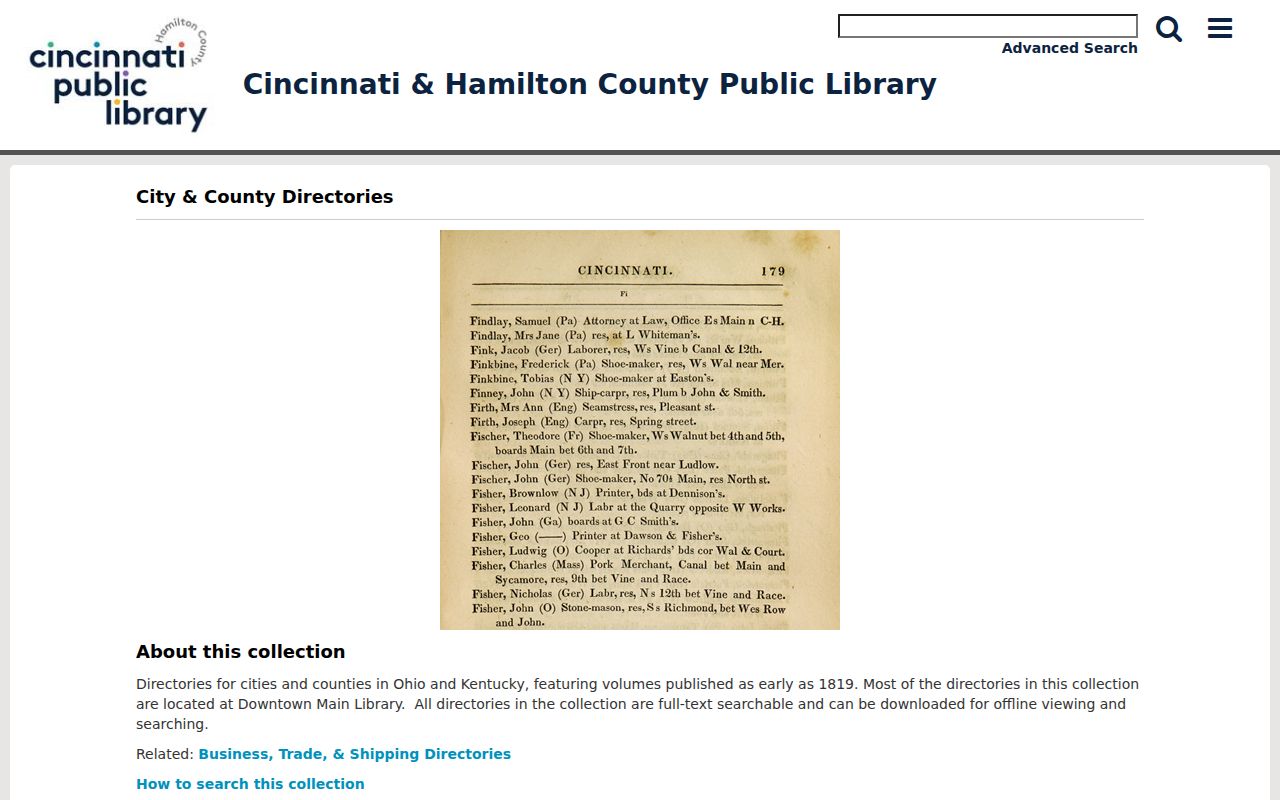
Hamilton's digital tools work from any home computer. Even so, they cannot turn the uneven verified run into a complete annual index for the city.
Hamilton Directory Research Desk
For a Hamilton directory question that starts on paper, head to the Cummins Local History Room on the fourth floor of Hamilton Lane Library, 300 N. Third St. The shelves hold local-history books, city directories, yearbooks, maps, atlases, and local newspapers. Genealogy material sits there too. Lane posts branch hours of Monday through Thursday 9:00–8:00, Friday and Saturday 9:00–6:00, and Sunday 1:00–5:00. Hours can shift. Call ahead before a long drive.
The directory year you need may not be online. The library's Local History & Genealogy service for Hamilton research offers a documented fallback. Staff take requests for property history. Obituary and newspaper work is included too, along with genealogy, local history, photographs, military research, and archived items. Give them an address, any spelling variants, and a date window. The more precise the request, the better the odds of a useful answer. The service page also links back to the Local History & Genealogy service for Hamilton research shown here.
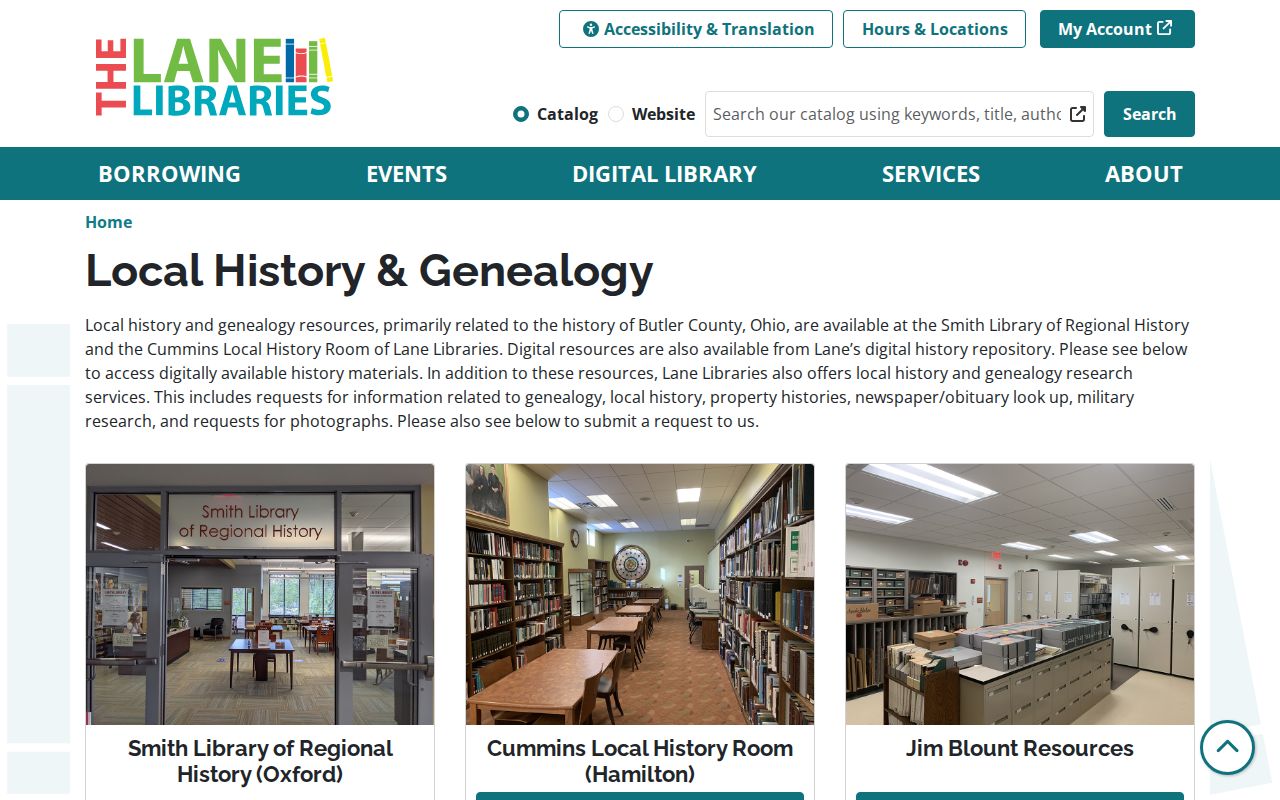
The request channel works well for narrowing a missing Hamilton volume, an address history, or a newspaper date before an in-person visit. It saves a trip.
Read Hamilton Directory Entries
A Hamilton city directory entry packs several claims into one line. Read it as fields, not a single statement. The 1968 Williams' Hamilton entries open with a surname and given names, may add a spouse in parentheses, then list an occupation or public service, a business or agency, and a residence notation. The 1964 street section works differently. Street headings, intersections, and numbered properties organize it. Occupants, business or vacant notes, and occasional rear-address or telephone notes complete each entry.
| Name line | Surname and given names, with initials or a spouse in parentheses when printed. |
|---|---|
| Occupation | A trade, role, or public service description, sometimes followed by an organization. |
| Residence | House number and street beside a printed residence notation. |
| Street listing | Numbered properties under a street heading, with possible vacant, business, rear-address, or intersection notes. |
| Publication year | The edition’s time frame, which should be compared with another record before dating a move. |
- Criss-cross directory
- The Hamilton street-order part of a directory, useful when an address is known before a name.
- Householder index
- A Hamilton alphabetical arrangement focused on the listed household name rather than a modern household roster.
- Abbreviation key
- The preliminary-page legend that defines the shorthand used throughout a particular Hamilton edition.
- Residence notation
- A printed indication such as h for home or r for resides, not a precise move date.
Hamilton Directory Street Sections
Later Hamilton city directories add a criss-cross route by address. Find the street heading first. Note its directional description and intersections, then read the numbered properties in order. People, businesses, vacant notes, and rear addresses all appear. The 1964 Heaton Street page shows the range. It is a historical layer, not a census of everyone at the address.
Fix the edition year first. Older questions and modern ones need different sources. For a current parcel or a long address-by-address chain, the Hamilton street directory route through the Auditor, Recorder, and GIS works better. Property rolls and deeds answer those. A directory street entry still shines for testing a past address against a household name and period.
Note: A street entry can help date a listed address, but it cannot establish continuous occupancy between publication years.
Hamilton Directory Gaps [INSIDER TIP]
Never guess to fill a missing Hamilton directory year. Lane's research form includes a dedicated Property History selection. A request can state the address, known surname spellings, and the needed time window. The Smith Library of Regional History in Oxford adds another Lane collection, with Butler and southwest Ohio paper records, maps, newspapers, photographs, books, directories, and yearbooks. A well-worded Hamilton request points staff toward the right shelf, microfilm, or local-history material. It need not claim the volume exists.
Trace Hamilton City Directories
Treat each Hamilton directory year like a checkpoint in a family timeline. Pick one surname and keep the printed spelling exactly as it appears. Then log the house number, the street, any spouse listed, and the occupation given. Small details add up. The federal census reaches through 1950, and Lane offers free in-library census searching covering 1790–1950. Census years and directory years rarely line up. So set them side by side, and let each source answer the questions it actually covers.
- Find the person in the earliest verified Hamilton directory volume near the expected period.
- Copy the Hamilton spelling, address, spouse notation, occupation, and edition year exactly as printed.
- Check the same directory year for Hamilton in the criss-cross section when an address is present.
- Move forward to the next available Hamilton directory year and compare only what the editions actually show.
- Pair the dated Hamilton entries with a census, deed, map, obituary, or probate source that fits the question.
A name that vanishes might mean a move, a death, a spelling shift, or a volume that simply never survived. Test the next source before turning absence into a conclusion.
Hamilton Directory Newspaper Layer
Newspapers can pin down a date that a Hamilton city directory only brackets. Lane documents runs spanning the Hamilton Intelligencer through the Journal-News. The runs sit on microfilm and in digitized form. They also appear through NewspaperArchive and Chronicling America, and as born-digital content. Coverage still has gaps. Search by title and time range first. Then decide whether a missing obituary or notice is truly gone. The Lane Historical Newspapers page displays what the library makes available.
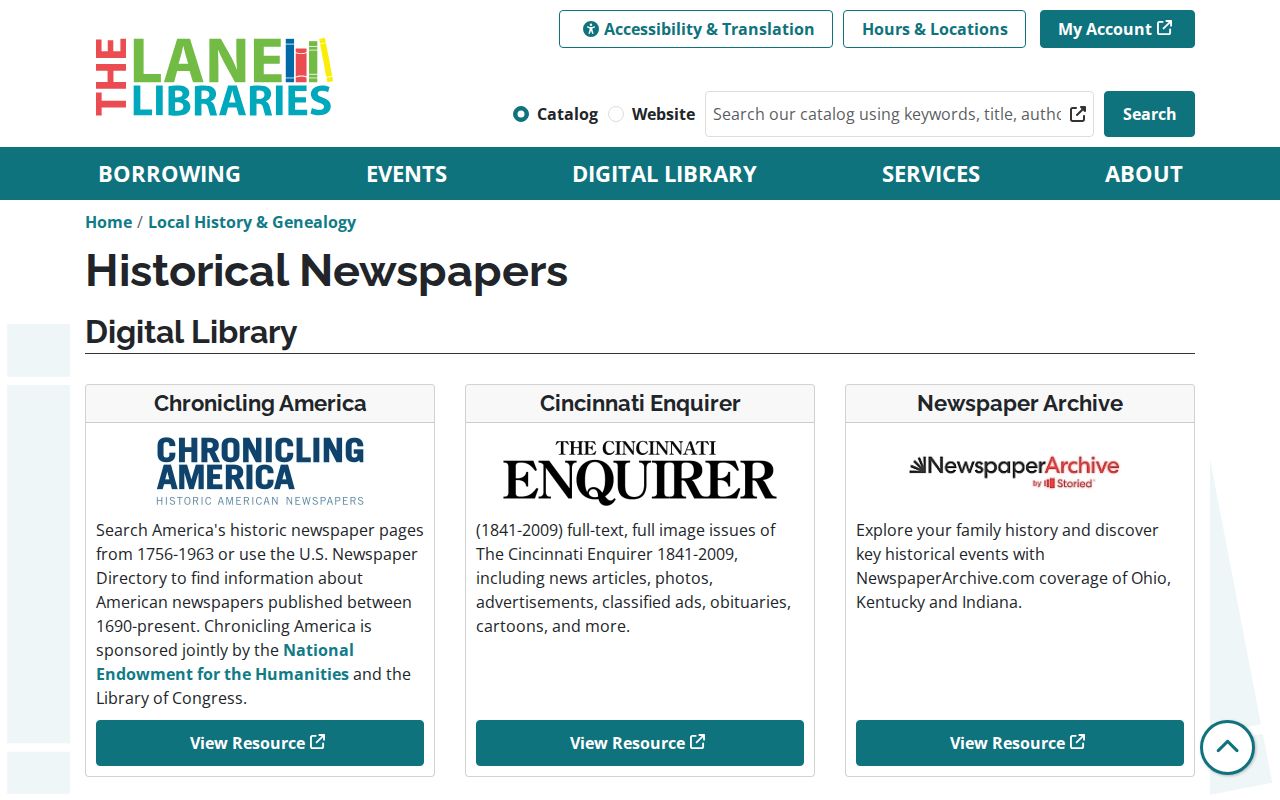
A notice can confirm a name, a relationship, an organization, or a stretch of years at an address. Read it against the publication date and whatever coverage actually survived.
Hamilton Directory Record Timeline
Hamilton's directory shelf belongs to a longer local-record story. Butler County was organized in 1803. The earliest verified online Hamilton directory volume runs 1858–59, though that is not proof no earlier printed city directory existed. Retention schedules now govern the City Records Commission. That explains why a historical search may wind between an active department, the Records Center, and a local-history collection.
- 1801 onward: FamilySearch catalogs Butler County deed books, with early general-index runs.
- 1858–59: First verified online Hamilton directory volume in the digitized collection.
- 1899: A free 63-sheet Hamilton Sanborn map offers building and block context.
- 1983: Cummins Local History Room was created after George C. Cummins’s family donated his photo collection.
Hamilton Directory Archive Partners
The Butler County Historical Society is housed at the historic Benninghofen House. It describes a regional genealogy research library and archive holding original documents, secondary works, publications, and photographs. For official county material, the Butler County Records Center & Archives serves as another Hamilton channel. It includes pre-1909 birth records. Miami University contributes its own local-source layer. That layer holds photos, manuscripts, newspapers, trade cards, oral histories, and archival primary sources. The Butler County Historical Society page shows the society's research offerings.
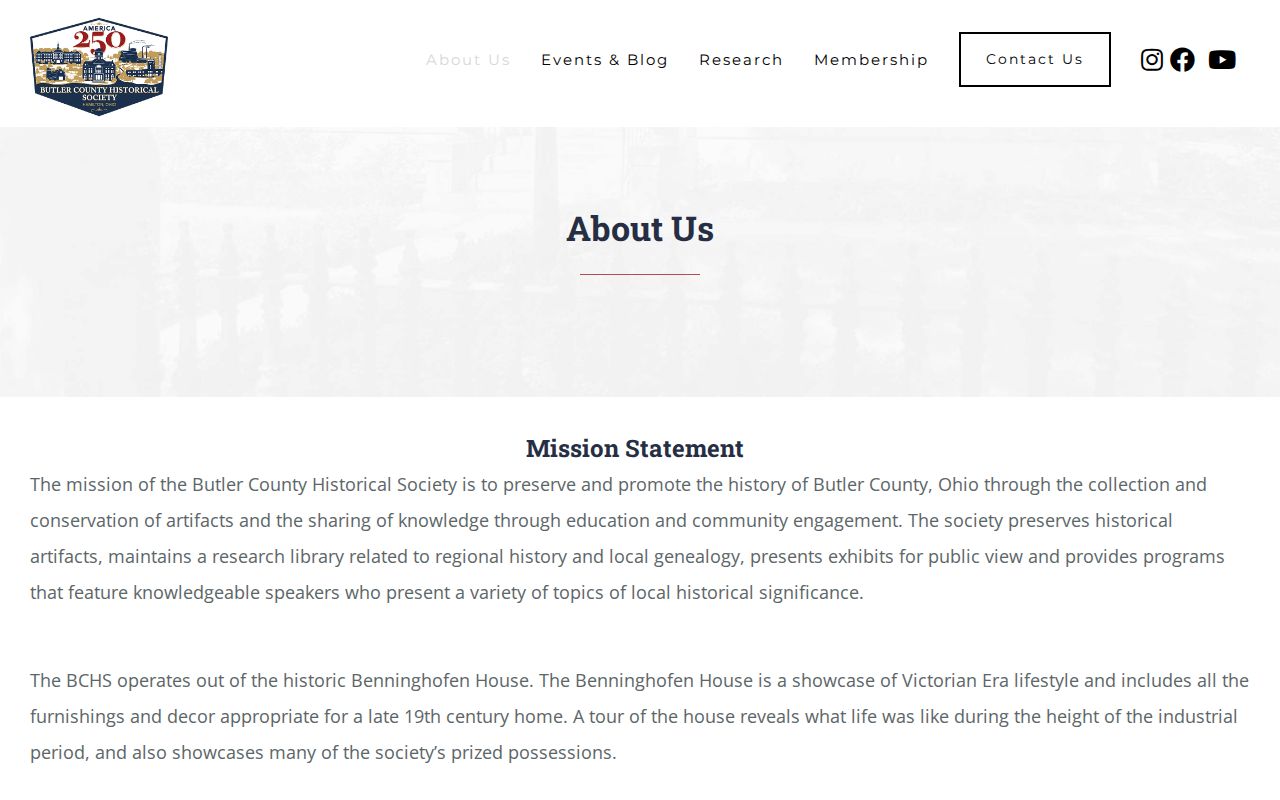
When a directory name needs photographic, published, or archival context, the society works as a complementary Hamilton repository. The next resource view is Miami University Digital Collections.
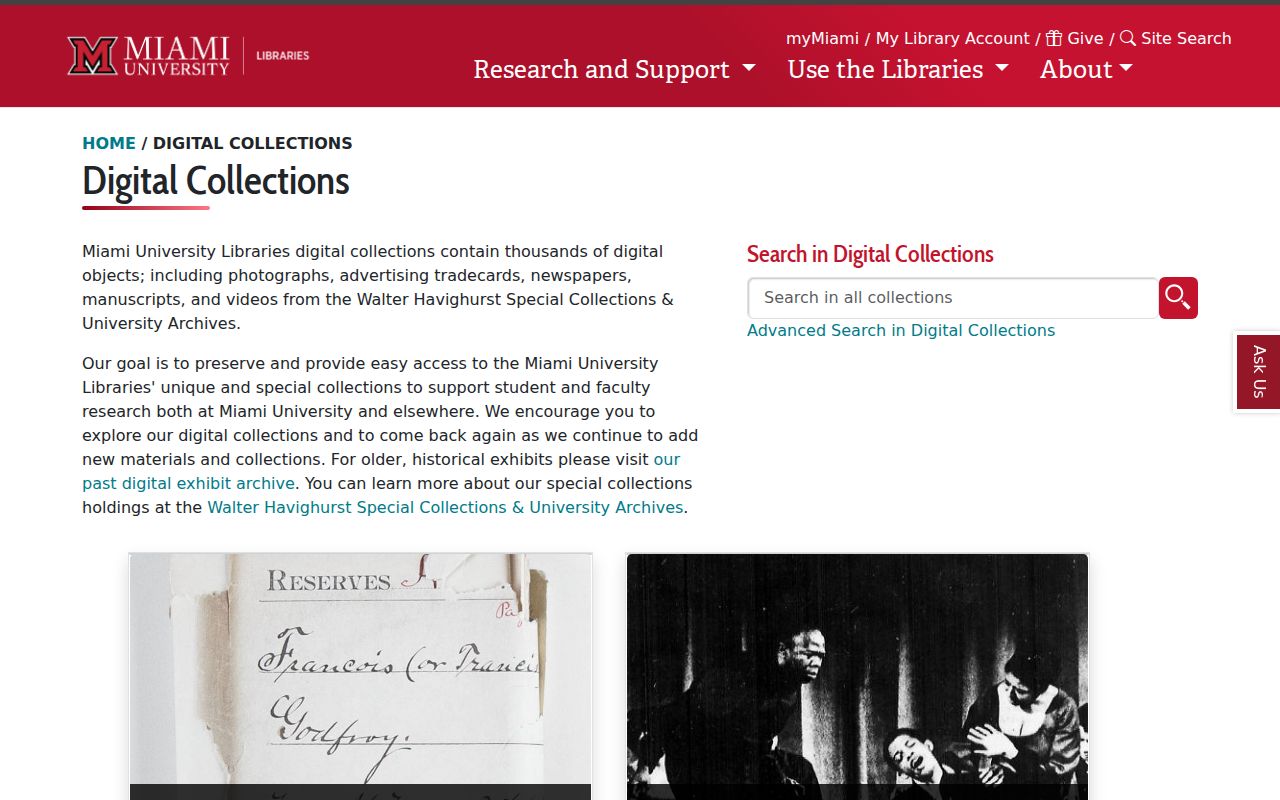
Miami's holdings supply rich historical context. Still, tie every name or address back to the matching directory edition and its custodian record.
Hamilton Directory Timing [MYTH]
No directory marks the exact day a person arrived or left town. The online Williams' run is incomplete. A printed edition can lag behind real events, and abbreviations only report what the publisher recorded. Check the edition year. Compare a second available edition. Then bring in census, deed, newspaper, map, or probate evidence before committing to a family-history claim about past residents of Hamilton.