
Hamilton Previous Residents by Era
A backward search of a Hamilton address works best as an era map. The current Hamilton parcel record gives a starting location and recent transfer lead. From there, the Hamilton Recorder’s modern documents, older indexes, Hamilton historic atlases, Hamilton directories, maps, and released federal census schedules provide different pieces of the address story. The records do not overlap perfectly. An owner in a deed may not be an occupant, while a directory listing may be late, abbreviated, or absent from an unverified year.
| Source | Years It Covers | Where Held | What It Shows |
|---|---|---|---|
| Hamilton Recorder documents | 1987 to present | Butler County Recorder in Hamilton | Recorded parties, dates, document number, book/page, and legal description. |
| Hamilton Recorder alphabetical index | 1797 to 1876; 1978 to 1987 | Recorder historical index in Hamilton | Party-to-book/page bridge; the 1803 to 1876 Red Books are arranged by surname initial. |
| Hamilton geographical and special indexes | Before 1987 | Butler County Recorder in Hamilton | City, township, subdivision, cemetery-deed, lease, and other location bridges. |
| Hamilton directories | Verified volumes from 1858-59 through 1975, with gaps | Cincinnati library’s Hamilton collection and Lane local history | Possible Hamilton address-to-occupant evidence, street section, and household context. |
| Hamilton Sanborn maps | 1899, 63 sheets | Library of Congress Hamilton collection | Hamilton building and block context rather than personal occupancy. |
| Federal census | Released through 1950 | Lane Library’s Hamilton databases and federal research channels | Hamilton household corroboration, not ownership proof. |
For a recent Hamilton address, start with the Hamilton Auditor and Recorder. For an older Hamilton address, use the same parcel and legal-description clues to find the correct index bridge before turning to a directory or map. The 1913 Hamilton flood can explain disruption in social and newspaper material, but no verified source establishes a blanket loss of Butler County deeds or court books.
Each Hamilton source answers a narrow question. A Hamilton deed dates a recorded transfer, a Hamilton directory supplies a dated listing, and a Hamilton Sanborn sheet places a structure on a block. Preserve the Hamilton source and year beside each note. That Hamilton record trail makes it easier to test a later name, a changed road, or an apparent gap without treating one record type as proof of everything.
Hamilton Records: Red Book Deed Bridges
The Hamilton Recorder’s historical indexes prevent the 1987 online boundary in Hamilton from becoming a dead end. Hamilton’s alphabetical grantor and grantee index reports coverage for 1797 to 1876 and 1978 to 1987. In Hamilton, the 1803 to 1876 Red Books are organized by last-name initial with separate grantor and grantee sections. Other Hamilton historical books use last-name and first-name initials. Once a Hamilton index supplies a book and page, use that reference to locate the earlier document image.
The Recorder alphabetical-index page is the historical party bridge behind many Hamilton address-history searches.
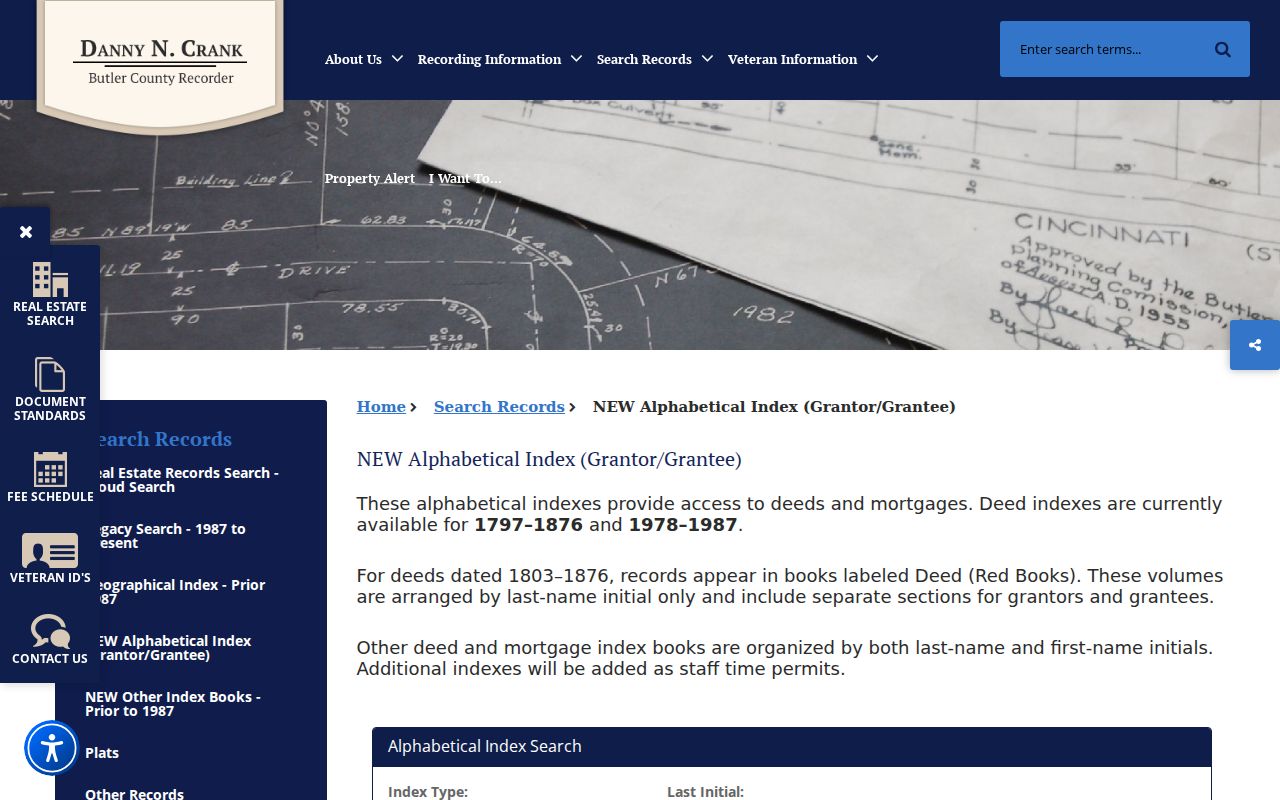
The index leads to a record reference, not a finished Hamilton house history. Check the resulting instrument for its parties and legal description, then compare that description to the Hamilton parcel in the next step of the chain.
Note: The Hamilton Recorder's current notice says imaging is complete, but a missing result or image should be checked with the office before treating the record as absent.
Find Hamilton Previous Residents in Directories
The verified Williams' Hamilton directory run is useful but not annual. It includes selected Hamilton volumes from 1858-59, 1861-62, 1871, 1875-76, 1883-84, 1892-93, 1894-95; a range of 1900s through 1923-24 volumes; then a verified gap from 1925 to 1953; and selected volumes through 1975. Preserve that uneven Hamilton coverage when following an earlier household. No entry in an unavailable year does not prove a move.
Read both the Hamilton alphabetic entry and the Hamilton street or criss-cross section. A 1968 entry can give surname and given names, spouse in parentheses, occupation, employer, and residence notation. The Hamilton street section groups a street with intersections and numbered properties, sometimes noting a listed occupant, business, vacancy, rear address, or telephone information. The local collections themselves are covered in depth on the Hamilton city directory page.
- Record the Hamilton street number, name, initials, spouse notation, and any address shown in an available alphabetic volume.
- Open the same Hamilton directory year’s street section and check the number, nearby intersections, listed occupant, and any vacant notation.
- Pair that year with the closest released census schedule for Hamilton and compare the household, without treating the census as a deed record.
- Return to the Hamilton Recorder or map when the address form, lot, or named party differs from the directory.
Hamilton Previous Residents Address Names
Hamilton address history can cross renamed roads and changing municipal geography. The City Street Index says the in-city Hamilton-Cleves Road portion became Pyramid Hill Boulevard, while Hamilton-Richmond Road is now Main Street. The digitized 1912 city guide contains a specific Alston-to-Charles note. An address search should try both the historic and current road term rather than assume the current spelling always reaches an older source.
There are other qualified clues. Joe Nuxhall Way is marked as formerly Forest Lake Lane, though the City list gives no effective date. Planning minutes document an April 1997 annexation around Stahlheber Road and northwest Washington Boulevard, with a zoning and property-line mismatch. Hamilton's 1854 merger with Rossville can likewise change how an older source labels a place. Use the Recorder's Annexations search or City Planning and Clerk records when the issue is municipal status or a street vacation.
Trace Hamilton Previous Residents by Deed
A deed chain traces legal transfers, not every household. Begin with the Butler County Auditor's property record for the current owner display, parcel identification number, and legal description. Then use the Butler County Recorder search for the purchase document. Match the parties, recorded date, document number or book/page, and legal description. A common surname by itself is not enough evidence to continue the chain.
- Save the present parcel's PIN, legal-description wording, and recent transfer clue from the Auditor record.
- Find the current buyer's purchase deed in the Recorder index using party, date, document, or legal-description information.
- Treat that deed's grantor as a prior-holder clue. Search the same person or entity as an earlier grantee while keeping the legal or subdivision reference aligned.
- Repeat one transfer at a time. At the 1987 boundary, use the alphabetical, geographical, or special historical index to obtain book/page information.
- Use a plat, inlot schedule, historic atlas, or current GIS when lot or subdivision changes make the street address unreliable.
- Grantor and grantee
- The grantor transfers an interest in the document; the grantee receives it. Their names are legal-party clues, not occupancy proof.
- Chain of title
- The sequence of recorded transfers linked by the same property description or related legal references.
- Legal description
- The lot, block, subdivision, or other property wording that identifies the land in the deed and survives address changes.
The FamilySearch catalog for historic Butler County deed material is another navigation point for historic deed volumes.
The catalog is helpful for locating historic material, while the parcel and Recorder chain remain the way to verify that a volume belongs to the same property.
Place Hamilton Previous Residents in 1899
The 1899 Hamilton Sanborn collection has 63 Library of Congress sheets. A Hamilton Sanborn fire-insurance map helps establish the building footprint, use, and Hamilton block context at that point in time. It does not name a resident. Pair it with the legal description, directory street section, deed date, or census schedule rather than using the map as a household record.
Recorder historic atlases offer another physical-context route, with published years 1836, 1855, 1875, 1895, 1914, 1925, 1930, 1958, and 1968. These map sources are most useful when a subdivision, lot, boundary, or street name has changed. They can explain how to find the right parcel, but they do not replace the underlying instrument or listed household source.
Hamilton Previous Residents [INSIDER TIP]
When the online directories have a gap, Lane Library offers a practical local fallback. Its Local History and Genealogy request form has a dedicated Property History option as well as obituary or newspaper, genealogy, local history, photograph, military, and archived-item routes. Give the exact address, known owner spellings, and a date window. That lets staff connect the request to the material actually held in the Cummins Local History Room or other Lane collections.
The Cummins Room is on the fourth floor of Hamilton Lane Library and holds local-history books, directories, yearbooks, maps and atlases, local newspapers, and genealogy material. The Smith Library of Regional History in Oxford holds Butler and southwest Ohio paper records, maps, newspapers, photographs, books, directories, and yearbooks. These library routes are especially useful when a digital record lacks the missing year or address detail.
Note: A focused address, name variant, and date window make the Lane property-history request more useful than a broad request for every person ever connected to a house.
Confirm Hamilton Past Households
A past household is not established by deeds alone. Directories can show a published address connection, while released federal census schedules can corroborate a household in a time period. Obituaries and local newspapers can add later context, and an estate or will may identify a death or successor clue. Butler County Probate Court and the Records Center are the appropriate local channels when a public estate trail needs checking, subject to court privacy rules.
Lane's newspaper directory identifies several Hamilton title runs, but it also warns that availability and ranges have gaps. Its library resources include in-library Ancestry Library Edition and free in-library U.S. census searching from 1790 through 1950. Use an obituary or census entry to test a timeline, then return to the deed, directory, or public estate file for the question it can answer.
The FamilySearch catalog for Butler birth and death originals points to filmed courthouse records from 1867 to 1908.
The catalog can help place a family event in the local record trail, but a birth or death record does not by itself prove where a person lived at a particular address.
Lawful use. Use Hamilton previous-resident records for personal, lawful house or family-history research, and never use public information to stalk, harass, or harm another person.